

THURSDAY
This is an essay I wrote in February 2023. It was nicely rejected from about every literary magazine in Dublin for being a touch too graphic and litigious, so now it is here. L’chaim!

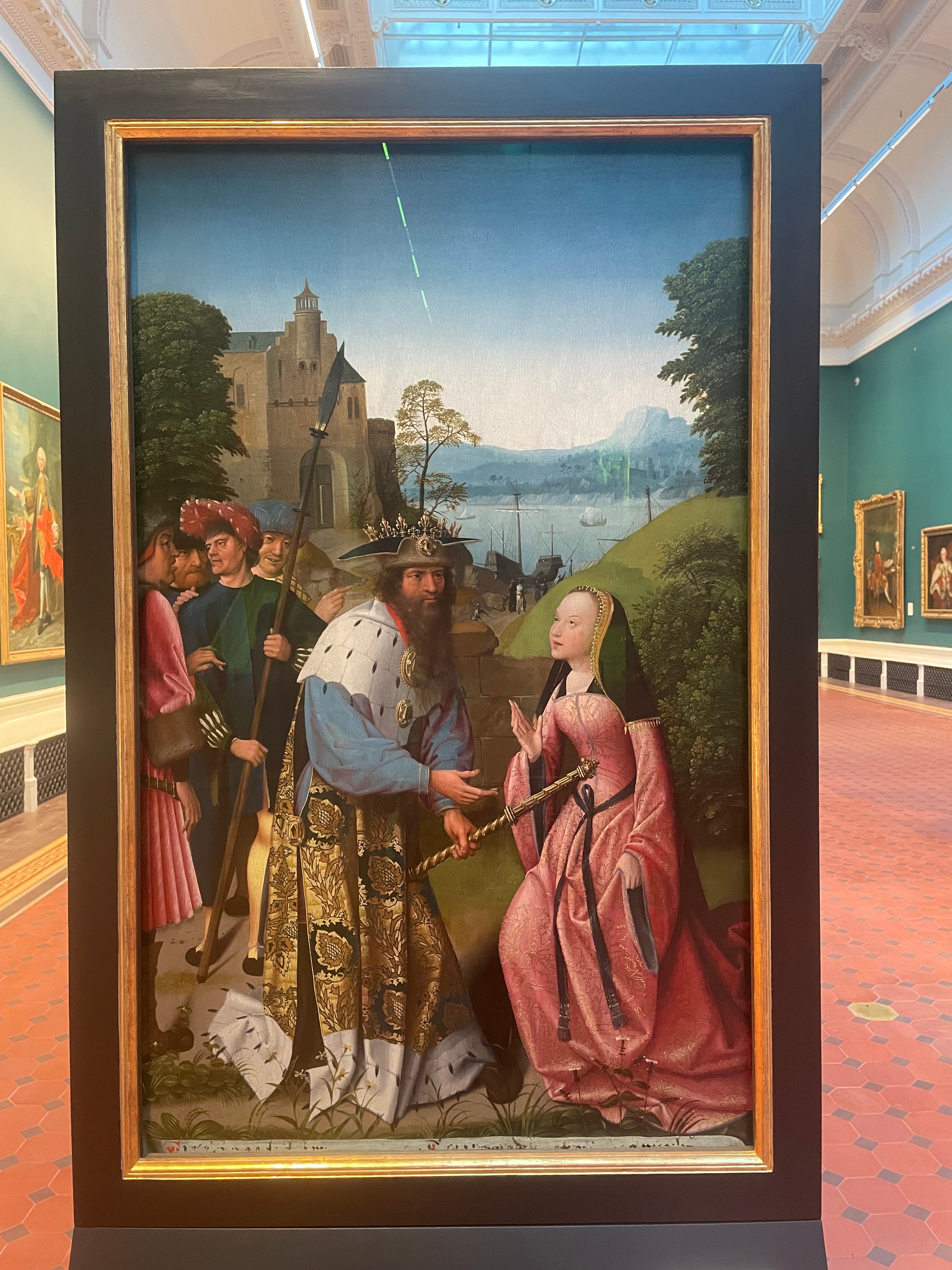
[Scenes from the life of St. Lucy circa 1505, Goossen Van der Weyden, oil on panel]
The threats are getting more specific. I bold, italicise, proofread the evidence file again, change the font. Legibility, style. I save the piece to my flash drive as a doc and pdf, because I forget which file type the Writing Centre printer prefers. In my stomach is the carsick feeling I only know otherwise from live performances. I close my laptop, put the flash drive in my pocket, take a red pen.
At the Centre, the printer is plugged in, the outlet switch flipped up, but the machine won’t turn on. First I was pressing the wrong button, the green one with a tiny house which means Home. The power buttons look different in Ireland. The police don’t carry guns here. The Centre’s four floors are empty, so I can’t ask anyone, and I don’t have time to wait, and I’m sure where I’m going will have a printer.
On the way to the DART, I see a poster on the side of a pub. It’s a cropped image of a man’s torso, pulling his buttoned shirt open to reveal some device. It’s either against heart disease or for smoke alarms, I’m walking too fast to check. The caption is Don’t Ignore The Signals.
I get a window seat facing forwards on the DART so I don’t get more nauseous. On the way south, the train goes past private backyards and balconies, their laundry hanging in the misted afternoon. We pass a section of Silicon Docks, where some tech companies hold their European headquarters. Before the skyscrapers of one-way glass, the Docklands were factories, shipyards, older churns of labour, more immediate exploitation. Before that, a marsh outside a mediaeval city. Where the gallows were, where they burned witches.
At Lansdowne, a yellow PSA says it’s only 800 metres to the American Embassy, and encourages me to walk to reduce stress. In the next 800 metres, I pass a junction box decorated in green which promises that Fibre Broadband is Now Here In Your Community. In the courtyard of a new luxury complex, four vaguely Grecian plaster statues of women arranged in a rectangle, twisting around with togas and flowers behind a metal fence. The eye-lines of the statues don’t line up. They can’t look at each other.
Inspired by a 5th-century ring fort, the American Embassy is a round, brutal building of concrete and mirrored glass, which also looks like a high school textbook’s illustration of rough endoplasmic reticulum. Yucca trees grow by the main entrance, which are from California, like me. The security checkpoint looks like most security checkpoints. A guard sees me waving on the other side of the bulletproof glass, and motions for me to move closer to the intercom.
“Hello,” I say in the device, as I’ve spoken into devices my entire conscious life. “I’m an American grad student, I’m dealing with a cyberstalker, I don’t think he’s in Ireland but the authorities back home recommended that I file reports locally. I have all the documentation on this flash drive, I wasn’t able to print it before coming here. Is there someone I can talk to?”
While that question buzzes up the chain of command, I turn away from the window towards the three-way intersection. Girls leaving school in groups and uniforms, bare-legged in January. Bird nest scrabbles in sycamore branches. A cyclist’s neon jersey says Be Seen Be Safe. Women push babies in strollers, tiny faces peeking from layers of knit and puffer tucked against the cold, through the crossroads. I turn back to the window.
The guard lets me into the checkpoint so I can talk to a woman, who can give me her first name but not her last. I explain that a guy I dated my first year of college has been leaving threats across my public social media, calling, texting. She asks what kind of threats. I say rape and murder, without stuttering. She asks if I’ve made a garda report, I say I’ve informed campus security but I knew the Embassy closed at five while the garda was open all night, so I wanted to get here first. She asks for my passport, to make a copy inside the rough-E.R.-shaped building, and asks me to wait while she sees what they can do.
It took me a while to get my passport. Long separated, my parents couldn’t agree what my surname was. My birth certificate is under my father’s surname, but my mother got full custody and tried to get my name changed to hers, to make it easier for us to leave America. My father’s lawyers did not appreciate that, so my surname remained his. It has benefits. From commercials I don’t remember acting in as a kid to my most recent poetry collection, I’ve always been known publicly as McGavin, under my mother’s maiden name. My legal life exists more privately. Miss McGavin is onstage with good posture, joking, trying to win an audience. Miss X is shivering under a hot shower. I got my passport when I was 18, able to fill out the paperwork by myself. In the picture, my hair is combed straight, pushed back from my shiny forehead. I am looking directly into the camera. I am trying not to smile.
The amount of other things I could’ve done today, I say to the guards. I’m fanning my face with the planner where I wrote the email addresses the woman with only a first name told me to write.
It’s stressing you out then, says the guard at the desk. Yes, I reply. It’s the first day back in lecture after holiday. I’m here for my master’s, I just wish I was at the library.
You’re at Trinity? says the guard by the metal detector. They must be working you hard.
They’re teaching me how to read, I say, it’s a great program. I don’t usually tell people I’m a writer, because then they stop acting weird around me and I can’t take notes, or they act weird in a different way. When asked, I usually say I’m studying literature.
For literature, continues that guard, they must have you writing so much. I took a business course over Christmas, I had to write six thousand words, it was so hard. He pulls his phone from his uniform pocket. It’s these things, they’re so distracting.
Absolutely, I reply. I turn my internet off when I’m working. It just doesn’t exist.
The Embassy woman returns with my 18-year-old face. Since his finances allow him to travel, and he might have a French passport, they’re gonna try to put a travel check on him so he can’t enter Ireland, but I can’t quote her on that. She says I did the right thing, seeing how he’s sent me weird messages in the seven years since we dated, but they’d never been violent before. It’s probably hot air, but it’s best to get these things down before they escalate. I can’t use the Embassy printer, too much security, so I’ll email the documentation.
On the way back to Lansdowne, a woman runs alone with her pit bull’s leash clipped to her waist. I pass a pretty bed-and-breakfast in Victorian brick called Ariel House. Ariel was the first character I ever played, in a children’s production of The Tempest: a sprite contracted to serve a magician until she’s freed in the finale. I was eight, with a bad stutter. My mom thought Shakespeare would be more fun than voice therapy. As I walk to the train, I am breathing how I’ve been breathing all week, how they taught us, in that little black box theatre that doesn’t exist anymore. Deep belly, in through the nose, out through the mouth. The kind of breath you need to project, to make sure the back row hears every syllable. The breath you need if you want to scream.
While waiting for the DART to Tara, I talk to a woman in a midnight blue puffer because she has a puppy. I miss my dog in the states, I explain to her and the black bulldog named Mario. Mario goes to work with her, he’s very well-behaved. The woman asks how I’m settling in at Trinity, with the literature degree. Lovely, just lovely. She doesn’t know any of the Contemporary Irish Women Poets I’m writing my thesis on, not even Eavan Boland, who was on the leaving certifications for a few years, I think. She lists who was on her cert, twenty years ago.
All the men, I say.
All the men, she says.
I am settling in well at Trinity. When I go earlier Thursday afternoon before the Embassy to make a report in the Head Security Office, the man is lovely. He has my mother’s father’s smile. The stalker has a common name with an English spelling, which he squints at. The first thing wrong with him, I say. The security guard takes a photo with his phone of an image on my phone, to print out and pin to the walls of different security stations around campus. Like a hamsa. It takes him a few tries to get a clear picture. I hate to say it, the Security man says as he zooms in, but they really do fit a certain profile.
This guy had hair when we dated, and no beard, I say to the musician, a friend who lives on the floor below me in the dorms. I’d ran into him on the way from the library, and asked if he had a minute to walk with me to the security office. When they have my information, and I have an email address to keep them updated, the musician and I go back outside, into the sun.
Is this why you changed your number? he asks.
Yeah, that’s what got me scared, I reply. It sucks, they only had NorCal numbers, like there’s literally no phone numbers left in LA, they’ve used them all, and I’m not from fucking NorCal. Anyway I’ve had crazy Internet comments for years, right, but they’ve never gotten my personal phone number before, so I changed it, but WhatsApp tells all your contacts if you changed your number, so he was still texting me, and making burner accounts on Instagram to say stuff, but one of the fake usernames—
What kind of stuff? the musician asks. He’s crossing his arms. What kind of stuff?
Just really violent and gross, I reply. Think of something really violent and gross, and that’s it. And I’d had a hunch it was him, or somebody I knew in-person, because I have a lot of firewalls to keep my things tight, like I do the same stuff as my journalist friends, or guys who really had to go out of their way to get foreign governments mad at them, but I write fucking poetry.
The women next to us under the bare sycamores are talking very quietly.
The musician and I start walking towards the mail room, a rugby pitch to our right. It sounds like you’ve dealt with this before, he says, and that sucks, dude. I’m sorry.
I’m just mad it ate my weekend, I continue. Like I’m fucking efficient but it was still six hours to check all the locks, right. And I thought it might be him, because he’s sent me stuff before about how I was so important to him, for the ten minutes we dated, and then I saw one of the new usernames and it clicked.
How? he asks.
The account was almondmilkXXXX, yeah, so XXXX is my birthday, so he’s trying to say he’s got all this info on me, and then when we dated, I’d tell him not to use almond milk because almond farming contributes to the drought in California, and that stuck in his head because he hasn’t slept with anyone since. Literally the most obnoxious person I’ve ever touched. I’d already been trying to break up with him, I remember, then on the night of the 2016 election, I’d been a poll worker all day, like up since five, and once the result was clear, he texted me I guess I can freely grab you by the pussy now, and I said he had to donate to Planned Parenthood before he tried to speak to me again. And after the inauguration he sent me a screenshot of his donation, and I said cool, still don’t want to be near you, bye, then he’d get drunk sometimes and send me crazy stuff over Facebook. So I saw almondmilkXXXX when I was at dinner and I was like oh, it’s Barnaby. It’s fucking Barnie. (For ongoing legalities, his name is Barnaby.)
Are you good? the musician asks. We’re stopped outside the mail room. The DART chatters overhead. I’m good, I say. It’s better knowing who it is than some random. I’m going to the sea on Friday.
Let me know if you need anything, like if you need to go anywhere else with somebody, he says. We hug. He leaves for the gym. I check the mail room for any of my names. I go back to my dorm to prepare documentation before visiting the Embassy and the garda.
Screenshots of Facebook messages from 2016-2017, including the last thing I wrote to Barnaby: does your mother know how you spend your free time? His email from 2021 saying how deeply I understood his interests, that he remembers how fondly I loved Paris and he hopes I can come to France soon. Screenshots of missed calls from an unknown number on Saturday, ringing me in the Dublin night on Pacific Standard time. A text with an LA area code, asking if it’s really rape if I enjoyed every second of it. Screenshots of Instagram burner accounts leaving comments throughout the weekend: rhiannonsrapist has started following you, which made me laugh because the singular presumes only one thing ever happened to me. rXmXXXXXX, composed of my public and private initials and birthdate, wants to slice me open and leave my carcass in a ditch. rXmXXXXX is upset I changed my number before he could have fun. I’m upset that the guy at the phone company call centre made more money from his hourly wage the previous Saturday, when the calls started, than I did that day from writing.
The phone company waived the normal fee to change my number. They have a policy in place for victims of domestic violence trying to escape the phantom words of their abusers, or so they can’t be tracked. This happens often enough that the 3rd-largest phone company in America, with 101.8 million subscribers as of 2022, has a policy for it. They extended the policy to me last Saturday, before I realised it was Barnaby, because I explained that I was a woman writer who this happens to, sometimes. I saved 36 dollars. 36 is a lucky number in Judaism. It’s twice eighteen, the number for life, chai, the 18th letter in the Hebrew alphabet. Double life. There’s said to be 36 righteous people in the world, always, no matter what. If any of them were missing, then the world would end. The final document is 11 pages long. I name it. I save copies to my desktop, flash drive, hard drive.
Once, in the same season as when I dated Barnaby but years later, one of the guys with a foreign government mad at him told me that he didn’t hold any bad feelings for his ex. She made him a better man. He liked my poetry much better, though. My poetry, he could taste. I found this charming that evening, my hometown’s palm trees whispering against the windows of his Airbnb. Later it was funny, for lots of reasons, one of which was the gap between our developments. The men I’ve let touch me have rarely made me a better person, or writer. Mostly, they’ve provided data. I put the flash drive in my pocket.
I respond to a text from Grace, saying she hopes I’m feeling alright after last night, and she’d be happy to help me make reports when she’s back in town. I thank her, say I’ve got a friend to go with me for support.
I take a red pen, Muji gel ink ballpoint in 0.5, from my desk, so I can circle Barnaby’s names and numbers once I have them printed out. I also take a seashell with an evil eye painted on it, which I made when I was 17 and something that had been happening for a long time stopped. I’ve kept it on every writing desk I’ve had. I put the pen and seashell in the same pocket of a canvas bag from a local bookstore, which is where I’d rather be. I bring my dopp kit: deodorant, face spritz, tissues, mints, chapstick, a rollerball of lilac perfume, red lipstick for when it’s over. I bring a sketchbook, watercolours, travel brush, earbuds, water bottle, a tangerine, because I don’t know how long this will take, what kind of lines, what state I’ll be in. I put my passport inside my wallet, same as when I’m preparing to travel.
I debate pushing off going to the Embassy and Garda until next week, when I’ve heard from the LAPD. Surely they’ll handle it fine, despite my previous experiences, and their public and private records. Despite the fact that the page labelled Internet Crime Prevention on the LAPD website is dated January 25, 2002, and the only crimes listed are Fraud, Pyramid Schemes, Online Auctions, and Teaser Pages. Campus security already knows what’s happening. He’s probably in LA, not Paris, two and a half hours by plane. I can’t find it, but I just got the Toklas cookbook from the library, and I want to start drafting something. Grace says no. Go now.
I check the mirror. No makeup, but groomed. I’m glad I straightened my hair last night for the first day of class, did my nails. I’m wearing a charity shop sky-blue button-up under an oversized tweedy sweater from a tante. I pull the collar out, adjust. Style, legibility. I look like a nice girl. Thermal tights under black high-waisted trousers, borrowed from a best friend, the same screenwriter who gave me the blue, white, black beaded bracelet on my left wrist. The girl who was driving, the week before I turned 18, and I was saying my birthday made me nervous, because as a minor you had statutory protections, like if someone did something you’d just have to prove it happened and it was automatically bad because you were a minor, but as an adult you’d also have to prove you didn’t want it. You weren’t just safe anymore. We were curving down the freeway exit into Hollywood’s electricity when she replied, casually, halfway between describing the weather or an omen, We were never safe.
The beaded bracelet is good for fidgeting, like the gold Scorpio signet ring left to me from another tante. Mixed-metal earrings from Nordstrom Rack that Grace complimented last night. An evil eye necklace from Susan Alexandria that I got on Black Friday, under my collar. I comb my hair back, tie it in a low ponytail. I think of my mother’s mother, brushing my hair a hundred strokes before bed. Back home, in a storage closet, there is a box of her play drafts. I think of the box every time I sign a book. Carroty mittens and a violet plaid scarf from my mother’s mother, pulled from the closet when I was home for the holidays. I put on a knitted hat from Aran in the shade Oatmeal, my favourite breakfast with strawberry jam. I could put a coat on, but I know the cool air will be refreshing, grounding. I pull on the black fleece-lined boots my mother gave me. I go. I visit the Embassy, leave, get back on the DART.
On the way from Tara to the Pearse Garda, I press my cold hands to my cheeks. An ambulance needles past. The sirens sound different here but pierce the same. It’s a short enough line at the station. Through the barred window, the sunset is pink, silvery, nacre. Mother of pearl. The door is open. The cool, humid air carries cigarette smoke and perfumes. It reminds me of particular early mornings in Paris, the summer before college started, the first place I went with my new passport. Orange juice with pulp. Walking around the neighbourhood where my mother’s mother’s mother once lived. Sneaking back into a tante’s apartment after seeing a boy with soft hands who liked raspberries, who I decided then was my real first kiss. I take the tangerine from my bag. I don’t peel it in one go, how my mother’s mother taught me, so I don’t earn a wish, but I wish I was back there anyway.
I text a poet, shorter than me, who was almost kidnapped off the street in Koreatown this time last year, if we could postpone our FaceTime because I’m in the middle of something. I text a comedian, whose cyberstalker approached us after a show in London a few months ago, when she’s coming to Dublin because I’m putting a calendar of visiting friends together. I text a journalist what time my train is coming into the seaside tomorrow. When I arrive, I will place my jewellery on a shelf above her boxing gloves in her spare room. As I take notes of the day for my records, my phone keeps correcting “previous” to “precious”. I keep deleting and retyping. Precious is a word I use more often. The phone remembers this.
On the station floor: caution tape lines faded from social distancing protocol, a brown smear which could be mud. To my right: a watery wall of reflective one-way glass, a door leading into offices. A pin board with flyers for Irish Tourist Assistance, things forgotten in taxis, people missing for decades. Beneath the flyers, in pen: stars, flowers, Lauren hearts David on one side, Lauren hearts David crossed out for CJ on another. Jesus hearts You. A question mark. Then just scratches, somebody too bored or anxious to shape it into language.
Two small girls circle the pin board on tiny scooters while their mother waits to speak. A few streets over from here, the statue of Molly Malone stands with her wheelbarrow and empty baskets. The exposed tops of her breasts glint like pyrite in the growing dark from a million photo opportunities.
There’s a mint and white sign to the left of the intake desk, a heart with a lightning strike inside and a medical cross over it, which says in Irish and English that there is a Defibrillator Available, Do Not Queue. There are marks along the outside edge of the round intake desk where people had leaned, rubbed, scraped over the years until the tan wood revealed its yellow grain. When I exhale through my mouth, I can see my breath.
The women in their winter coats before and behind me in line: I will not say what I overheard as they explained what was happening in their lives. It’s not mine. This is mine. I want to talk about food and fabrics and sunlight and all the other ways that the earth laughs. This is what I have right now.
On my phone, I get a notification that a magazine launch I wanted to go to starts soon. I read about Brigid, one of the women my mother was named after. Brigid is the patroness saint of Ireland. Next week, her feast day will mark the beginning of spring. It will be celebrated as a public holiday here for the first time, the first named after a woman. I am in the middle of reading about her hobbies, which included poetry, healing, and dairy production, when a man in a puffer vest the colour of shit at the end of the queue tells me to get off my phone, it’s my turn.
I give the story to the garda behind the desk, who has a neat shorthand. It is the third time today I’ve explained in full what’s happening to an authority figure. I don’t know how many times I’ve explained it in the last week to my friends, floor-mates, and family.
I give the garda my flash drive. I start to say what the file is called so he can print it out, then I make a noise, and he says it’s all right, these things are difficult, except I’m not crying, I’m laughing, because I thought I’d find a printer by now. I didn’t think anyone else would see that I named the evidence file FUCK_OFF.
When he comes back out from the office to say their computer only accepts encrypted flash drives, the man in a puffer vest the colour of shit is yelling at the girls on scooters. One of them almost ran over his foot, he says. He’d already told her off ten minutes ago. This man, ten minutes ago, chose not to move away from the hectic paths of the girls, but stayed exactly where he was, fists dug into his vest.
It’s dangerous for them to be doing that, he says to the garda. There could be bleeding consequences. The garda leans over the desk. What kind of consequences, mate. What are you yelling at kids for.
If a junkie was in here, and they ran over his foot, I’m just saying, there’d be consequences then. Their bleeding mother should be minding them, continues the man, speaking to the garda. He does not look at their mother, who is clenching the handle of a stroller, the undercarriage filled with snacks and picture books. The baby boy stares around at the echoes. The smaller girl is shaking. I am holding very still at the intake desk. I feel angrier than I have in months. The garda tells the man to stop hassling the kids, be quiet, sit down, he’ll hear him in a minute. The shithead listens to the man in uniform. The girls listen to their mother, who sit across the station from him and stare at the floor.
I write down another email address to forward my documentation. I go across the street to the bookstore for the magazine launch. I missed the poetry reading. I don’t hear anything else they say.
The night before, on Wednesday, I was about to leave for dinner with Grace when I got a text from the weird number with an LA area code. One unread message, under the yellow text pinned to the top of every WhatsApp log: a lock followed by Messages and calls are end-to-end encrypted. No one outside of this chat, not even WhatsApp, can read or listen to them. Tap to learn more. Then, in the grey chat bubble: a No symbol followed by This message was deleted.
He deleted the message before I could read it. The message existed so that I knew he had my new number.
I was tired, and late for Grace’s reservation. I took a screenshot, emailed it to myself for the documentation file. I texted it to my mom, as I’d texted her all the screenshots I’d collected in the last week. Eight hours behind in LA, she was preparing to go to the local police. I’ll call you in 90 when I’m back from dinner, I wrote. Yes please mon choux! she wrote back. So glad you are in a castle fortress!
On the walk to dinner, I thought. It was very weird that some random found my number. It had to be someone I knew in what we call real life. An old classmate, a coworker. Somebody’s teen cousin who’s read too many creepy forums and didn’t like the bits of my work that get periodically memed, then saw me in a yearbook. Walking through the Green, I consider every guy I’ve met who dislikes me enough to brainstorm threats, and also has the free time to make burner accounts.
I walked too far through the fog, I doubled back to find the restaurant. I remembered the email Barnaby sent in 2021, early November, the first time in a few years I hadn’t posted a couple’s costume on Instagram for Halloween. I remembered the voice note in French he sent me, summer of 2018, two phones ago: he’d seen a photo of my friends and I at the beach captioned post-therapy glow, and he was concerned that I needed therapy, and he was also there if I needed him. In a screenshot from Sunday, Barnaby’s actual account with his sleep paralysis demon of a profile picture had started following me 37 minutes before rXmXXXXXX wanted to slice me open and leave my carcass in a ditch. Idiot. To have ever put my private moments in public, to have not known that WhatsApp automatically updates anyone who’s saved you as a contact if you changed your number.
But I knew who the caller was now. It would get handled. I would call my mom once I was back, update the file. I would enjoy Italian food at this new restaurant with my new friend. I shoved my phone into my coat.
From the rooftop, the Dublin skyline reminded me of Los Angeles: the house lights, match heads prickling the night. It hurt. There were two memorials I should’ve been home for that week. I sat away from the window, facing Grace. I told her it was special to have met, because my mother’s father’s mother was named Grace. She came from somewhere out west and did not look back. I told Grace the long story, a usual story. When men and history were done with Grace, she had two sons, and she was telling fortunes in the desert. It’s silly, I told her, it’s all the cliches, psychic Irish granny, California spiritualism. Except. Whenever I need to make a hard choice, or get a weird hunch, or know that something is worth remembering, I’ll need it later– I tell myself it’s Grace showing the way. Grace understood. We talked about Rebecca Solnit, another Irish-American Jew wandering out of California. Grace wanted to read more of her work, to prepare herself to write about the Repeal campaign. I gave my spiel.
Solnit is most well-known these days for her 2008 piece Men Explain Things To Me, often described as the first viral essay, when the mechanisms of virality had just begun forming. The piece starts with an anecdote about Solnit and a friend going to a fancy party. The host, a fancy man, says he heard Solnit wrote books, and asks what her latest was about. When Solnit replies with the name of a 19th-century photographer, the fancy man summarises her own book reviews before he finally notices her friend’s interruptions. Solnit expands that assumption of expertise, that smothering, to all the arenas of life where women are not believed for their own experiences, despite any body of evidence they bare.
It’s an incredible essay. It clarified a lot for me, at a time when I was calling myself a young woman but was still a teenager. However, I wish that Solnit’s other work was as widely shared. It sears that one of the best historians of our time must write, over and over again, about sexual violence, the old problem which churns itself new. As she concludes, most women fight wars on two fronts, one for whatever the putative topic is and one simply for the right to speak.
The book on the photographer that the man explained to her, River of Shadows, is one of my favourite texts. Solnit traces the development of the film camera alongside the building of the rail system in California. The film camera, she argues, can be seen as man’s attempt to control time, while the train is his attempt to control space. Both developments were heavily financed and directed by Stanford’s founder. One artistic whim and one financial.
I think the Internet is where the camera meets the train. When they started stringing up telephone poles in California, they followed the railroad tracks out of convenience. Broadband, when it came, was laid under the telephone poles. If you take the Amtrak today, you can see telecommunications satellites and Amazon warehouses between dry almond farms from the train window. Men with money made decisions about how the world should behave, and now that’s where we live. We are doing our best with the looking glasses we’ve been given, tools that change faster than our emotional language, let alone the law. The skeins of power are not hidden in the landscape. Look through the smog. Of course ARPANET started here. The Internet is man’s attempt to annihilate both time and space, to cross distance in an instant and preserve a moment for eternity. The first message sent through ARPANET in 1969 to Stanford University from UCLA (where I met Barnaby), was a mistake. One of my thesis advisors was a grad student then, in the gut of the maths building. He meant to transmit the word LOGIN. The system crashed after two letters. The first message sent through the academic and military network which became the World Wide Web was LO.
LO, like Lo and behold. Lo, he stood by his burnt sacrifice, Book of Numbers, 23:6. Lo, I’m telling a story, and I’m sure I know how it ends.
When Grace went to the bathroom, I checked my phone. Two hours before, almondmilkXXXX had started following me. He commented twice on my most recent Instagram post, the post he’d been commenting on all week. The picture was a flyer for a memorial fundraiser for my friend. A writer who was working on multiple manuscripts and television projects when she passed, before the new year.
When are you back from Dublin?
Has your mother ever been r*ped? I guess she’ll be experiencing that soon.
The skyline which was not Los Angeles blurred. Probably hot air. A calm voice said home, now. Grace got the check, a takeaway box as I stuttered through what happened. My mom’s about to file the report, I tried to explain. It’s better knowing who it is, honestly. I thought it was one of the usual guys who want to kill me because they want to fuck me or fuck me because they want to kill me.
Grace didn’t laugh at my joke. She understood. She walked me through the dark back to the dorm. I climbed to my room, and turned on the desk lamp. I was back early. It was time to call my mother. Speak to ya soon was her last text. I called my mother. It rang.
The threat had been posted two and a half hours before. I called again. She didn’t pick up. I texted calling you. I texted hello??? I called again. I texted mom. I called again.
In her phone, my contact was saved as a childhood nickname, which she still called me in public, at literary events, and made me go red. In my phone, she was saved as mameleh. Mom who’d never had her only child live so far away, who couldn’t hug me if I called crying. She kept pulling things to keep me warm from the closet when I was back for the holidays. She wouldn’t let me go out at night as a teenager if I had wet hair, or if it was a full moon. Mom who had her own tactics for fleeing exes, McCarthyites, auditors, but didn’t know what incel meant. Despite her precautions, she would sometimes do what her mother did and talk for hours with strangers in the front yard. Mom who never met Barnaby, didn’t know what he looked like.
I changed her passwords from Dublin last Saturday to keys complicated enough to be secure but easy enough for her to remember. I begged her to quit smoking when I was ten, because a teacher said that the tar from one cigarette stays in your lungs for fifteen years, and she had to live forever. Sometimes, I heard her singing the last words of Molly Bloom’s soliloquy from the kitchen.
yes I said yes I will Yes
Mom who lived alone in Los Angeles, with the dog.
I called again.
She answered.
She’d been in another room, cleaning, she didn’t hear the phone.
I wasn’t in Dublin anymore. I wasn’t myself. I was in a park in my old area code, the number I’d had since I was nine. I was in the park where I’d hidden at dusk because we had to go home but I wanted to keep playing. I heard her calling my nickname, then my full name, over and over. I could see her across a lawn, and then she saw me crouched in the bushes. When I screamed on the phone, it was the sound she made back then on the other side of the green as I ran, stuttering out that it was a game, I’m sorry, just a game.
Hope is not a lottery ticket you can sit on the sofa and clutch, feeling lucky. It is an axe you break down doors with in an emergency.
After the 2016 election, I pinned that Solnit quote on the wall of my freshman dorm, a line I’ve taped over every writing desk I’ve had since then. When I finished talking to my mom, I felt hopeful. I was prepared.
I would shower, eat a few bites of leftovers. Sleep. Wake up at dawn sweating, strip off the glow-in-the-dark menorah pyjamas Mom gave me for Hanukkah. Sleep more. Wake before my alarm, on Thursday. I would get up, dress. I would eat a yogurt during class break, too nauseous earlier for orange juice and oatmeal. Pick up the cookbook I’d requested from the library after lecture, run into the musician outside our dorm. Security office, explain. Mail room. Dorm, prepare the documentation and flash drive. Embassy, explain. Garda, explain. Red lipstick. I would leave the bookstore with my friends, pass Miss Malone on the way to a pub, get drunk and bum rollies and tell everyone they have perfect cheekbones and I won’t vomit like I thought I might and then it will be late again and I’ll pack for the seaside and watch videos of the dog that Mom sends me and I’ll realise I forgot the cookbook in the security office and text the musician if he could grab it, early train tomorrow, and it’s late and I hope the strollers and scooters are put away and all the kids are in bed.
But first, I would wake up on Thursday morning. If I dreamed, I don’t remember.